The Aluminum Myth:Why ZeoCharge™ Does Not Make You Aluminum Toxic
Updated: Jul 26

One of the most common concerns people have when first learning about zeolite supplements is aluminum. Because zeolites are classified as aluminosilicates, some people assume that taking a zeolite product would increase aluminum exposure in the body. For individuals trying to detox heavy metals, this can understandably sound concerning. However, this concern largely stems from a misunderstanding of how zeolite minerals are structured and the different forms of aluminum that exist. When the chemistry and stability of clinoptilolite zeolite are understood, it becomes clear that ZeoCharge™ does not contribute to aluminum toxicity.
What Zeolite Contains Aluminum:
ZeoCharge™ is made from purified natural clinoptilolite zeolite, a volcanic mineral formed when volcanic ash interacts with seawater over long geological periods. This natural process creates a highly organized crystalline structure made primarily of silica and alumina. Because aluminum is part of this crystal framework, zeolites are classified as aluminosilicates. But the aluminum present in zeolite is not free aluminum.
Instead, it exists as aluminum oxide embedded within the mineral’s rigid crystal lattice. In this form, the aluminum is locked into the structure of the mineral itself. It is not loose, bioavailable aluminum that can detach and be absorbed into the body.
The Difference Between Aluminum Oxide & Metallic Aluminum:
When people talk about aluminum toxicity, they are usually referring to free or metallic aluminum that can interact with tissues in the body. The aluminum found in ZeoCharge™ is aluminum oxide, which behaves very differently. Aluminum oxide is considered a stable ceramic material rather than a reactive metal. Because it
is embedded within the zeolite framework, it does not behave like the forms of aluminum associated with toxicity.
The Importance on Silica Content in Zeolite Stability:
According to zeolite researcher Karl Hecht, whether aluminum can detach from a zeolite depends largely on its silica content. The higher the silica content, the more stable the mineral structure becomes. Clinoptilolite naturally has a high silica content, which is one reason it is used in supplements. ZeoCharge™ contains nearly 75% silica, giving it an especially stable structure. This high silica content helps keep the aluminum locked within the crystal lattice as the mineral passes through the digestive system.
The Safety Difference of ZeoCharge™:
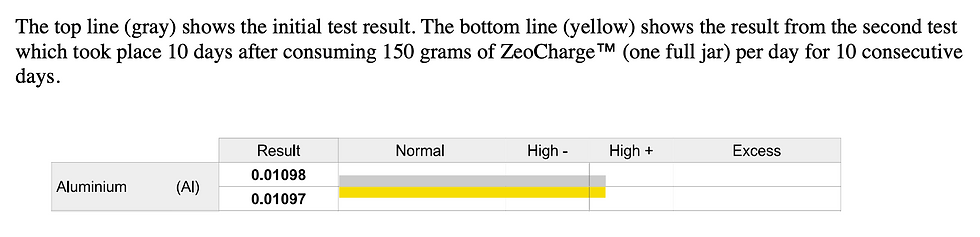
Before ZeoCharge™ was brought to market, Zeolite Labs conducted testing to ensure that the product would not increase aluminum levels in the body. To determine whether consuming a very high dose of ZeoCharge™ could lead to tissue accumulation of aluminum, a test subject consumed an entire jar of ZeoCharge™ (150g) daily for ten consecutive days—far exceeding typical use levels. Aluminum levels were measured before and after the trial, and the results showed no increase in aluminum levels in the body.
10 Days on 150g ZeoCharge™ Per Day
In addition to this trial, countless client case studies such as the reports below have shown that individuals using ZeoCharge™ often experience reductions in tissue aluminum levels over time.
16 Months on 30g ZeoCharge™ Per Day

9 Weeks on 6TBSP. ZeoCharge™ Per Day, 34.5% Aluminum Reduction

2 Months on 6TBSP. ZeoCharge™ Per Day, 28.3% Aluminum Reduction

Microscopic blood analysis can provide a visual snapshot of this same aluminum reduction. In dry blood analysis, features such as a dense outer dark ring around the sample, is commonly associated with heavy metals and chemical stress. The two client samples below illustrate the transformation ZeoCharge™ has had on detoxing one’s internal environment over time. As toxin burden is gradually reduced, shifts in blood patterns can begin to appear, reflecting a cleaner circulating environment and improved cellular conditions.


Aluminum Bottom Line:
Although zeolites are technically aluminosilicates, the aluminum contained within ZeoCharge™ is not bioavailable and does not behave like free aluminum in the body. It exists as aluminum oxide that is structurally bound within a stable mineral lattice.
Because ZeoCharge™ contains nearly 75% silica, the structure remains highly stable as
it passes through the digestive system, preventing aluminum from being released.
Testing confirms that ZeoChargeTM does not increase aluminum levels in the body and may even support reductions over time. When the chemistry of clinoptilolite zeolite is understood, the concern that ZeoCharge™ could make someone aluminum toxic does not hold up.
Check out "The Detox Experience" Podcast which is home to real stories, real data, and real conversation around detoxing with ZeoCharge™
Visit our ZeoCharge™ FAQs page for more product info
Check out our "Zeolite Dosing Paradox" document:
Use promo code "zeolite" at checkout for 10% off!


Comments